
Why is The Experience of We?
A brief glimpse
Want more depth?
Read on:
Relationship is the leverage point.
We are living through a moment of unprecedented complexity.
Our lives are more interconnected than ever — technologically, economically, globally — yet our shared realities are fragmenting.
We inhabit different informational worlds, different narratives of meaning, different definitions of safety and truth. Even within families, friendships, and communities, it’s becoming harder to feel like we’re on the same page.
This fragmentation isn’t only cultural or ideological, it’s physiological and relational.
We feel it in our bodies.
Our nervous systems evolved to regulate with each other — to share the energetic costs of focus, sense-making, and responsibility across relational fields.
When shared reality breaks down, we’re all forced to carry the full cognitive, emotional, and physiological load alone.
The result is widespread exhaustion, anxiety, polarization, and a growing sense that we are bracing for something without knowing what it is.
The Experience of We begins from an aching truth: There’s got to be a better way.
Literally. Our global civilization cannot keep going like this. Nor can other species, nor can the biosphere.
And there are better ways.
Many of them are already felt or known — by everyone from indigenous communities, to children, to scientists, to you in We.
And thus, many responses to this moment focus on ideas, identities, or infrastructural systems:
Better information, technology, politics, policies, personal coping strategies …
But without the capacity to inhabit a shared reality, none of these can be integrated sustainably.
The Experience of We begins at a different layer.
We do not attempt to respond to this predicament from the top down.
We work at the scale where change is actionable: between people.
By restoring the conditions for shared reality — in relationships, groups, and communities — we regain capacities that cannot be accessed alone:
Collective sense-making
Co-regulation under stress
Resilient dissonance
Shared response-ability for the future we are creating
This isn’t about returning to the past or dissolving individuality.
It is about learning how to move forward together in a world that now requires the wisdom of our distinct perspectives, combined.
No single person or in-group can solve the metacrisis–polycrisis.
And very few of us have direct access to the levers of mass civilizational change. Most of us do not control governments, markets, technologies, or institutions at scale.
But everyone has influence in their relationships.
Every person participates, every day, in at least one relational network: family, friends, work, community, and more.
It is within these relational spaces that values are transmitted, nervous systems are regulated, and sense and meaning are made — all of which shape the decisions we make, both individually and collectively.
Civilizations do not change only through policy or power.
They change through how people relate, moment by moment, long before those patterns are ever formalized into systems.
We can turn disempowerment into agency.
The Experience of We exists in part to address a quiet but pervasive despair:
the feeling that the problems we face are too big, too complex, and too distant for our lives to matter.
The Experience of We offers a different form of agency.
Not the fantasy of individual control, but the real, embodied capacity to influence the quality of the relational fields we inhabit.
When relationships shift,
nervous systems co-regulate,
decisions harmonize,
cultures re-orient,
and systems eventually follow.
Relationship is not “small scale,” in the same way trees aren’t “small scale.”
It is the substrate from which all large-scale systems emerge.
This is enough to truly matter.
When enough relational spaces become more coherent:
less extractive
more honest
more regulated
more aligned with life
the larger systems that depend on them cannot remain the same.
This is how lasting change propagates — not through domination, but through fractal coherence.
We’re not asking for permission.
We’re taking responsibility for the one place we always have leverage:
the space between ourselves and others.
The Experience of We is built on the conviction that:
What we practice in relationship, the world becomes.
Something inside us already knows.
We’ve all felt it — a quiet ache, an underlying sense that something’s not quite right.
Maybe it’s the heaviness in our chest when we see a living tree cut down or a forest stripped bare.
The lingering unease about where our world is headed.
The indignation as we witness the grotesque human and more-than-human suffering.
Or the hollow disorientation as the stories we once trusted unravel.

This is the Polycrisis touching us — not just one problem, but a tangle of them:
Ecosystems crumbling, wealth gaps widening, communities fraying, politics faltering.
These crises don’t sit alone; they amplify each other, pushing our collective systems to their limits.
And yet, the pain we feel isn’t only about what’s happening out there — it’s what’s happening in here:
A tremble in the nervous system.
A fray in the web of trust.
A sense that something essential has been lost.
Within the context of The Experience of We, the Polycrisis isn’t just a series of external problems.
It’s also a deeply felt internal state of overwhelm, fragmentation, and relational disconnect.
We didn’t evolve as 7.8 billion separate minds.
Homo sapiens co-evolved as close-knit tribal bands with a shared consciousness.
A living network designed to sense, decide, and care together.
In that ancestral relational field, we could distribute the work of being human.
Threat detection, emotional regulation, and meaning-making were held together.
Cut off from that relational field, we burn through energy like a fire without fuel.
The exhaustion, alienation, and despair so many of us feel — they’re not personal failings.
They are the predictable symptoms of a shared consciousness that’s been fractured.
At first glance, the root cause might seem to be inequality, political dysfunction, or environmental mismanagement.
But if we follow the thread inward — beyond the headlines, beyond even our own words — we find a deeper unraveling: a fracture in how we make meaning, together.
Some call the collapse in our meaning-making the Metacrisis.
Others point to the structural crises of the Polycrisis.
Both name real dimensions — but together they reveal something deeper still:
The Experience of Separation.
Something inside us already knows.

We’ve all felt it — a quiet ache, an underlying sense that something’s not quite right.
Maybe it’s the heaviness in our chest when we see a living tree cut down or a forest stripped bare.
The lingering unease about where our world is headed.
The indignation as we witness the grotesque human and more-than-human suffering.
Or the hollow disorientation as the stories we once trusted unravel.
This is the Polycrisis touching us — not just one problem, but a tangle of them:
Ecosystems crumbling, wealth gaps widening, communities fraying, politics faltering.
These crises don’t sit alone; they amplify each other, pushing our collective systems to their limits.
And yet, the pain we feel isn’t only about what’s happening out there — it’s what’s happening in here:
A tremble in the nervous system.
A fray in the web of trust.
A sense that something essential has been lost.
Within the context of The Experience of We, the Polycrisis isn’t just a series of external problems.
It’s also a deeply felt internal state of overwhelm, fragmentation, and relational disconnect.
We didn’t evolve as 7.8 billion separate minds.
Homo sapiens co-evolved as close-knit tribal bands with a shared consciousness.
A living network designed to sense, decide, and care together.
In that ancestral relational field, we could distribute the work of being human.
Threat detection, emotional regulation, and meaning-making were held together.
Cut off from that relational field, we burn through energy like a fire without fuel.
The exhaustion, alienation, and despair so many of us feel — they’re not personal failings.
They are the predictable symptoms of a shared consciousness that’s been fractured.
At first glance, the root cause might seem to be inequality, political dysfunction, or environmental mismanagement.
But if we follow the thread inward — beyond the headlines, beyond even our own words — we find a deeper unraveling: a fracture in how we make meaning, together.
Some call the collapse in our sense-making the Metacrisis.
Others point to the structural crises of the Polycrisis.
Both name real dimensions — but together they reveal something deeper still:
The Experience of Separation.
So continues our Sacred Story.
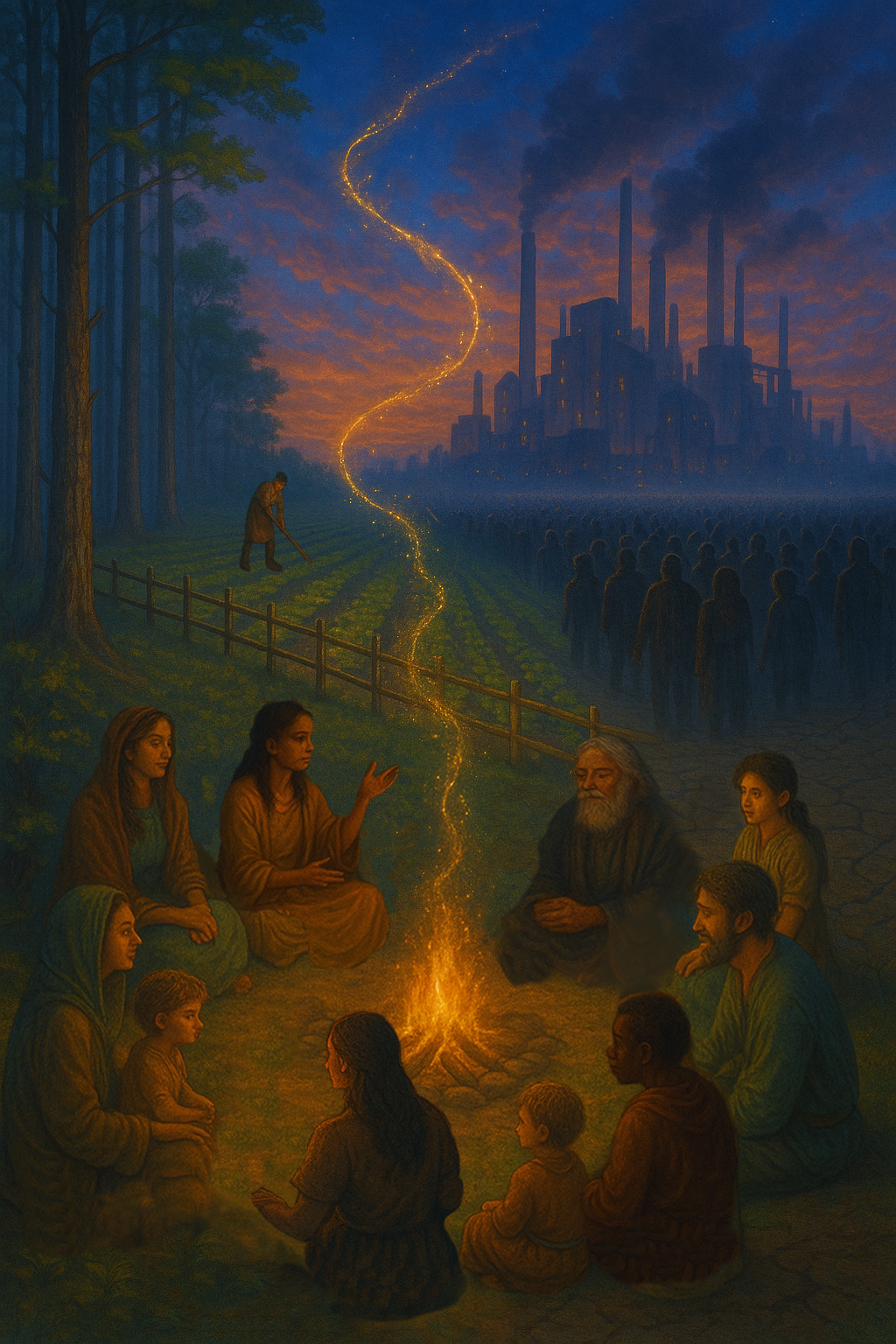
Long ago, we walked gently with the Sacred Foundation — the essential living systems of Earth that cradle all life.
We moved as tribal collectives, setting our pace by the natural rhythms: the rising and setting of the sun, the waxing and waning of the moon, the passing of the seasons.
We took safety in each other’s eyes and each other’s arms.
Our stories were braided into the wind, the rivers, the soil.
But there came a time when we began reaching beyond Momma Earth’s gifts, taking more than her rhythms could renew.
This ecological overshoot stirred a quiet fear — scarcity whispered, and we listened.
From tribal wanderers, we turned to fields and fences, then to empires and machines, each step an attempt to control what we feared might slip away.
That fear birthed domination within our cultures, a turning away from the circle of we to the fortress of me.
Survival, once woven in community, became a lonely labor.
In healthy growth — whether in a person or a people — Separation is a season, a developmental phase.
It brings self-awareness, agency, creative distinction.
But when the return arc into deeper connection is blocked, Separation hardens into relational pathology: a systemic condition of chronic disconnection.
The nervous system adapts to treat Separation as if it was our safest, most natural state.
Our capacities — to repair ruptures, to trust again, to weave back into the whole — weaken.
Cut off from the regulating currents of a healthy relational field, we began to extract harshly from Momma Earth.
Tearing at her soil, her water.
Trying to soothe the ache through material salvation.
Our relationships thinned, shaped more by need than reverence.
Even now, with devices in our hands and voices in our ears, speaking across continents, we often find ourselves alone.
We are immersed in thousands of hollow connections while the real roots dry out.
We are caught in a feedback loop:
The more disconnected we become, the more we rely on extractive coping just to stay calm, and the less able we are to sense and respond to the consequences — further intensifying the crises.
In the face of these crises, many of us are overwhelmed and afraid.
Some long to return to an imagined past.
Others want to set fire to the whole system and watch it burn.
Both are responses to fear.
One collapses into control.
The other fractures into nihilism.
From a systems lens, these are attractor states — recurring behavioral patterns that arise when systems are under stress.
They promise relief from overwhelm, but diminish the Sacred Fire, compromising life’s ability to flourish.
We need another way.
A strange attractor between control and chaos.
A Third Attractor.
That’s why The Experience of We exists.
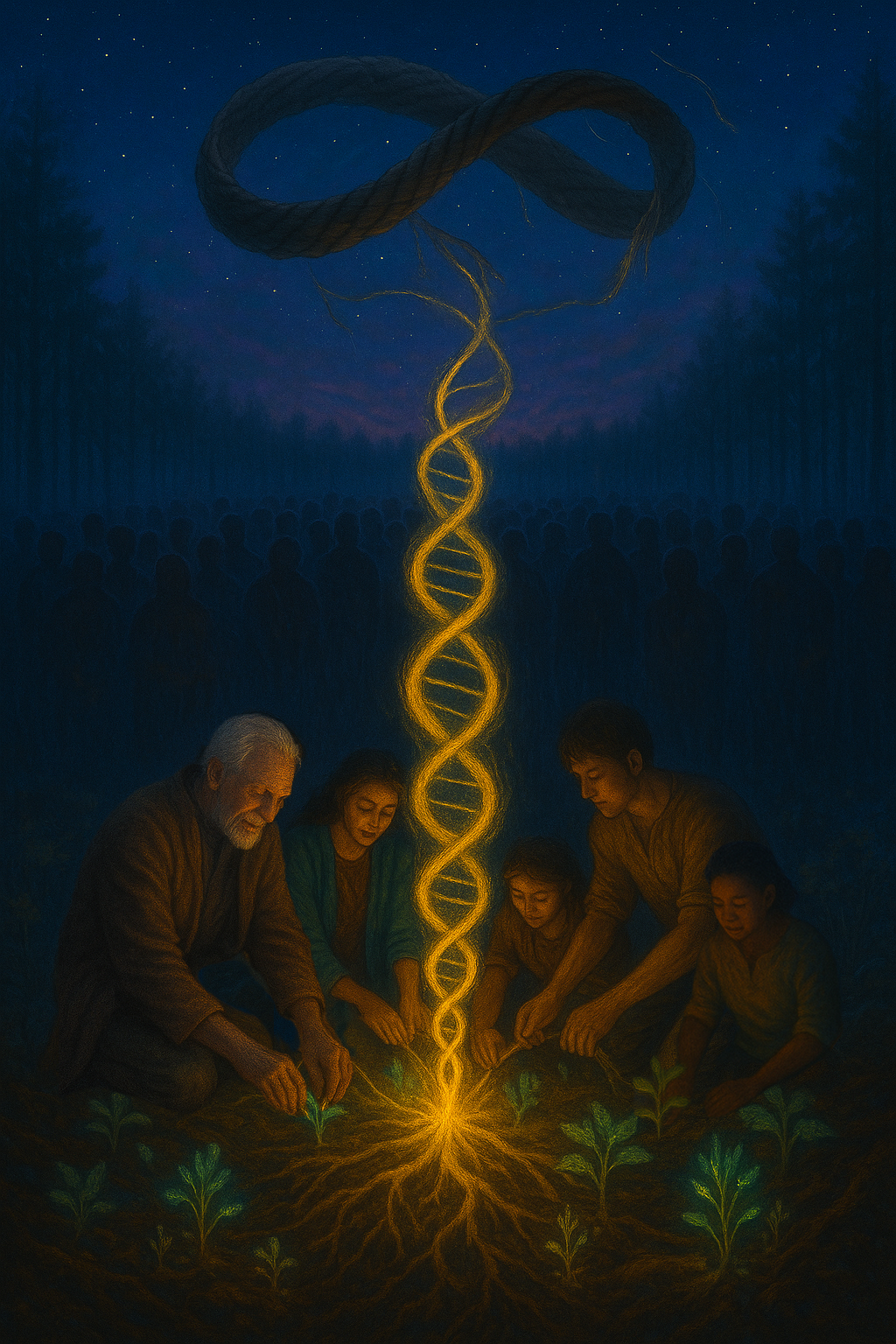
Not a product. Not a brand. Not a utopian dream.
A living, evolving process.
Shared rituals that synchronize our nervous systems.
Conversations and cognitive tools that re-weave shared understanding.
Experiential processes that remind us what it is to be truly connected — to each other and to the Sacred Foundation.
The Experience of Separation is not just cognitive.
Not merely an illusion.
It’s embodied and emotional.
Passed down through generations of dysregulated nervous systems and patterns of disconnection – from each other and from the Sacred Foundation.
We can’t “fix” it by thinking harder.
Technology alone will not save us.
We must restore the relational field we evolved to depend on –rebuilding the architectures of rhythm, story, touch, trust, and shared meaning.
This is the work of shifting from Relational Pathology to
We Consciousness, where our relationships with ourselves, each other, and the living world become increasingly attuned, regenerative, and life-affirming.
But let’s be clear: shifting from Separation to We Consciousness requires devotion.
It has a heavy upfront energetic investment.
It demands that we choose consciously, relationally, repeatedly.
It requires decisions that sometimes run against the grain of our culture and conditioning, until the new pattern stabilizes.
Yet once rooted, it gives back more than it takes.
Relationships that nourish us.
Systems that sustain us.
A felt belonging in our larger ecological family.
And it could make all the difference.
In these times of breakdown, it’s tempting to believe nothing we do matters.
That the systems are too big, too broken.
But complex systems don’t change through mass agreement –they shift when enough of the right connections come into coherence, even among a few.
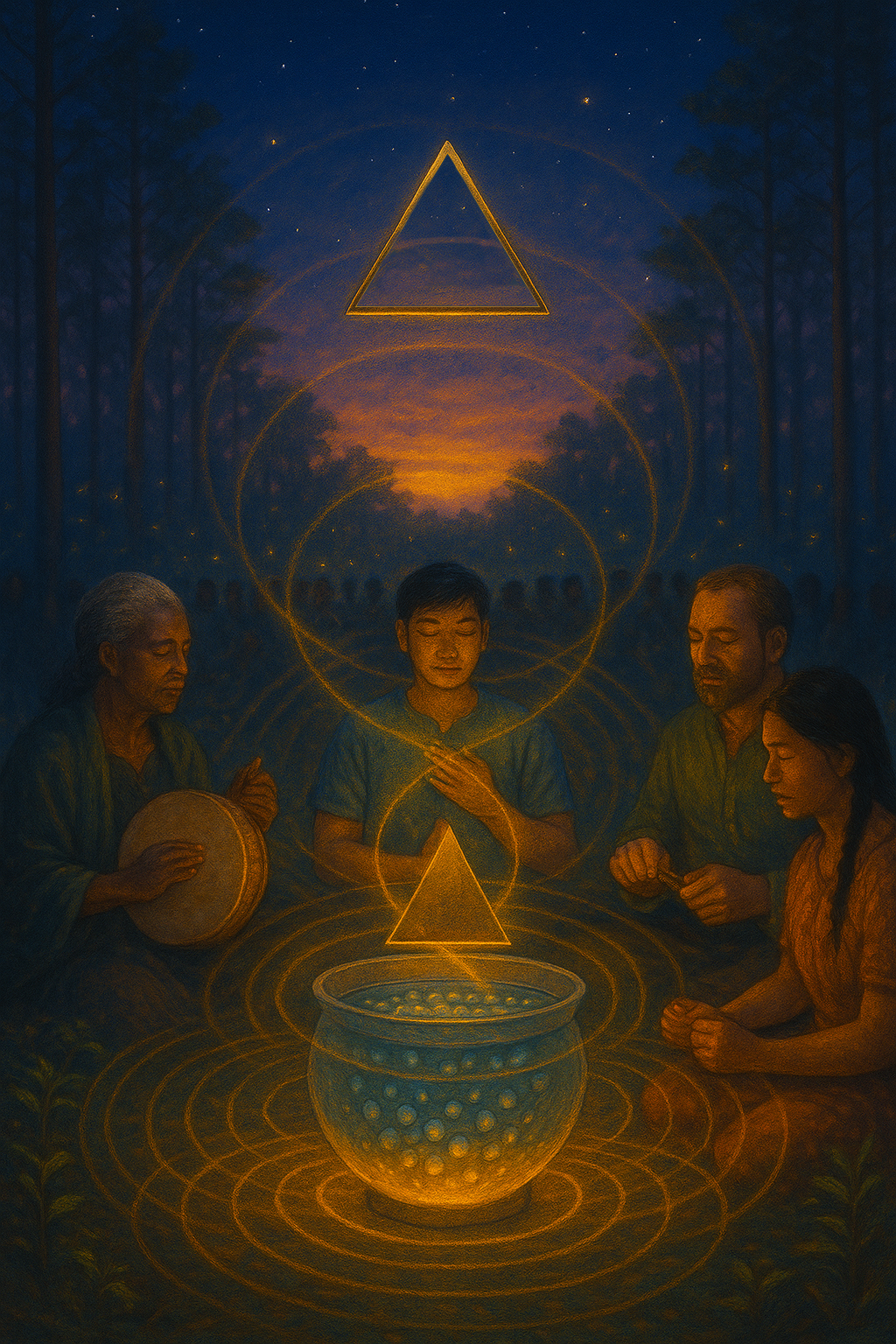
When a critical mass of us come together — hearts open, grounded in reverence — we can shift the tide.
Imagine a pot of water, heating on the stove.
It doesn’t boil because every molecule is equally hot — it boils when enough molecules reach a tipping point, and their movement cascades through the rest.
Systems scientists call this a moment of criticality — that tender edge where a seemingly small shift can ripple through everything.
And that pot of water is a living, complex system.
Just like us.
We don’t need everyone to be awakening.
We don’t need everyone who is awakening to be fully awake.
We just need enough coherence among a catalytic few.
If even a small percentage of us can fully embody and stabilize in a new way of being — metabolically, emotionally, relationally — we can become what systems theorists call a strange attractor:
A living pattern that keeps drawing the rest of the system toward it.
Not through persuasion.
Not through power.
But through resonance.
This isn’t just metaphor.
This is fractal emergence.
In networks of fireflies, if a few blink in rhythm, soon the whole field glows in unison. Not by explicit coordination — but because synchrony becomes the path of least resistance.
This is called a synchronization cascade.
It happens in neural networks, ecosystems, and civilizations.
And it means a seemingly small change can ripple outward through the whole system.
If we become the pattern life is longing for.
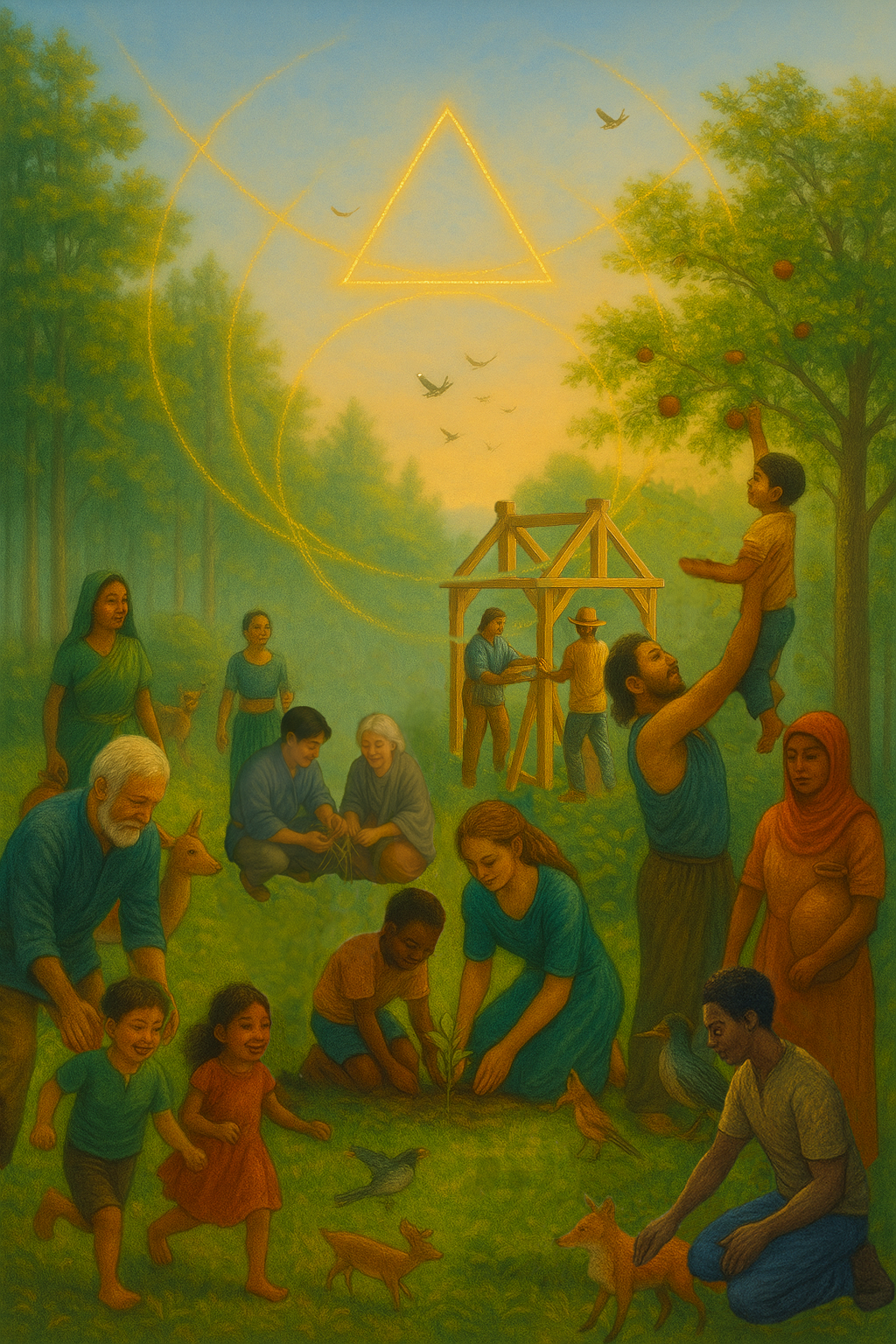
If Authoritarianism and Anarchy are responses to fear,
We Consciousness is a response to life.
It doesn’t erase difference.
It harmonizes it.
It belongs to no single person, culture, or plan.
It’s a recursive pattern that can emerge anywhere,
whenever beings choose to relate from presence instead of protection.
The Experience of We is about completing the developmental arc
from Separation into mature Distinction within Unity, bringing the gifts of individuation into service of the whole.
And as our path meets the horizon line — where the story echoes in your own footsteps — know that this is not a conclusion.
It is a threshold.
So let us return not to systems theory, but to something deeper.
Something older than language or concept.
To our breath.
To our heartbeat.
To the wind in the trees.
To the relationships we so cherish.
And to the Sacred Spark of mystery we all carry.
Because even when the Polycrisis is a distant memory, we will still need something to guide us.
Not control, not ideology, but coherence born of care.
So if you are healing that trauma no one else can see …
planting a communal garden …
or building trust across impossible divides …
Then you are already part of this strange attractor.
The Experience of We is here to name it, nourish it, and make it visible — so others can find their way in.
Because the field is shifting.
And it doesn’t require everyone.
Just enough of us.
Coherent enough.
For long enough.
In love enough.
To become the pattern life longs for.
The Earth is listening — let’s not wait for permission.
What stories will we weave into this next chapter of life?
Let's write them.
Together.